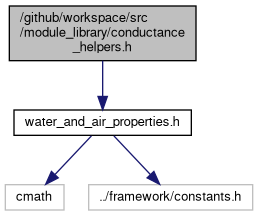
#include "water_and_air_properties.h" Include dependency graph for conductance_helpers.h:
 This graph shows which files directly or indirectly include this file: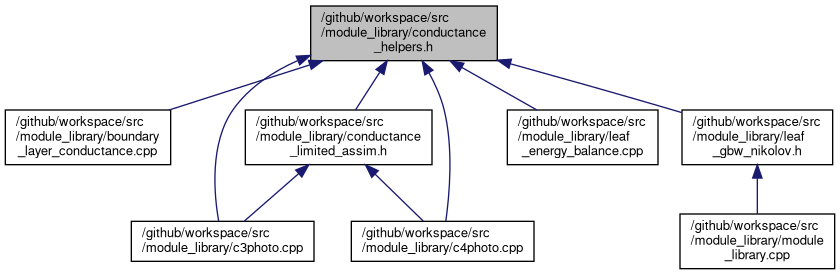
Go to the source code of this file.
Functions | |
| double | g_to_mass (double const pressure, double const conductance, double const temperature) |
| Convert a conductance value from a "molecular" basis (in units of mol / m^2 / s) to a "mass" basis (in units of m / s). More... | |
| double | g_to_molecular (double const pressure, double const conductance, double const temperature) |
| Convert a conductance value from a "mass" basis (in units of m / s) to a "molecular" basis (in units of mol / m^2 / s). More... | |
| double | sequential_conductance (double const conductance_1, double const conductance_2) |
| Calculates the total conductance across two sequential gas paths. More... | |
Function Documentation
◆ g_to_mass()
|
inline |
Convert a conductance value from a "molecular" basis (in units of mol / m^2 / s) to a "mass" basis (in units of m / s).
There are two different conventions for specifying gas concentrations and fluxes, which leads to two different units for conductances. As a reminder, for a one dimensional gas flow at steady state, the relationship between these variables is F = G * deltaC, where F is a flux, G is a conductance, and deltaC is the difference in gas concentration at the two ends of the gas path.
- The "mass" basis: In this convention, gas concentrations are expressed as mass per volume (typically kg / m^3) and gas fluxes are expressed as mass per area per time (typically kg / m^2 / s). Thus, conductance must be expressed as length per time (typically m / s).
- The "molecular" basis: In this convention, gas concentrations are expressed as a fraction of total molecules (typically mol / mol) and gas fluxes are expressed as molecules per area per time (typically mol / m^2 / s). Thus, conductance must be expressed as molecules per area per time (typically mol / m^2 / s).
Converting between these conventions is not always straightforward. In the simple case where temperature and pressure are constant across the gas path, it can be shown that G_mass = G_molecular * molar_volume, where molar_volume is the molar volume of an ideal gas at the given temperature and pressure.
We often use this conversion in BioCro, even when temperature is not constant across the gas path, because errors due to this approximation are expected to be small.
See g_to_molecular for the opposite conversion.
- Parameters
-
[in] pressure Pressure along the gas path in Pa. [in] conductance Conductance along the gas path in mol / m^2 / s. [in] temperature Temperature along the gas path in degrees C.
- Returns
- Conductance along the gas path in m / s.
Definition at line 47 of file conductance_helpers.h.
References molar_volume().
Referenced by check_leaf_temp(), leaf_boundary_layer_conductance_campbell(), and leaf_energy_balance().
Here is the call graph for this function: Here is the caller graph for this function:
◆ g_to_molecular()
|
inline |
Convert a conductance value from a "mass" basis (in units of m / s) to a "molecular" basis (in units of mol / m^2 / s).
See g_to_mass for more information.
- Parameters
-
[in] pressure Pressure along the gas path in Pa. [in] conductance Conductance along the gas path in m / s. [in] temperature Temperature along the gas path in degrees C.
- Returns
- Conductance along the gas path in mol / m^2 / s.
Definition at line 71 of file conductance_helpers.h.
References molar_volume().
Referenced by leaf_energy_balance().
Here is the call graph for this function: Here is the caller graph for this function: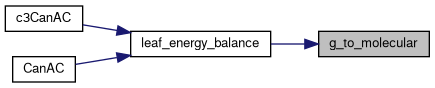
◆ sequential_conductance()
|
inline |
Calculates the total conductance across two sequential gas paths.
If gas flows from location A to location B and then to location C, there are two sequential steps: A to B (step 1), and B to C (step 2). Using one dimensional gas flow equations, we have:
F_1 = G_1 * (C_B - C_A) F_2 = G_2 * (C_C - C_B)
where F_1/F_2 are fluxes across steps 1 and 2, G_1/G_2 are conductances across steps 1 and 2, and C_A/C_B/C_C are concentrations at A, B, and C.
At steady state, F_1 = F_2 = F, and the flux across the entire path is given by
F = G_T * (C_C - C_A)
where G_T is the total conductance across the path. Solving for G_T, we can find that 1 / G_T = 1 / G_1 + 1 / G_2.
- Parameters
-
[in] conductance_1 Conductance along one step in any conductance units. [in] conductance_2 Conductance along the other step in the same units as conductance_1.
- Returns
- Total conductance along both steps in the same units as conductance_1.
Definition at line 111 of file conductance_helpers.h.
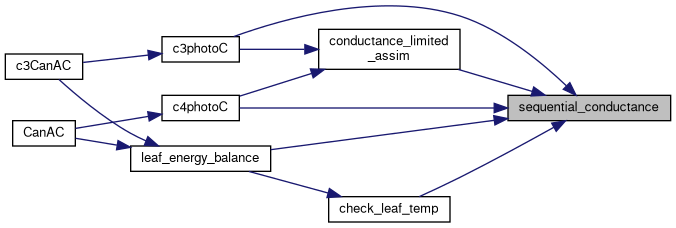
Referenced by c3photoC(), c4photoC(), check_leaf_temp(), conductance_limited_assim(), and leaf_energy_balance().
Here is the caller graph for this function: