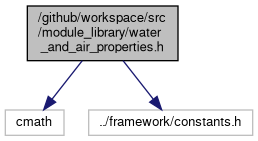
#include <cmath>#include "../framework/constants.h" Include dependency graph for water_and_air_properties.h:
 This graph shows which files directly or indirectly include this file: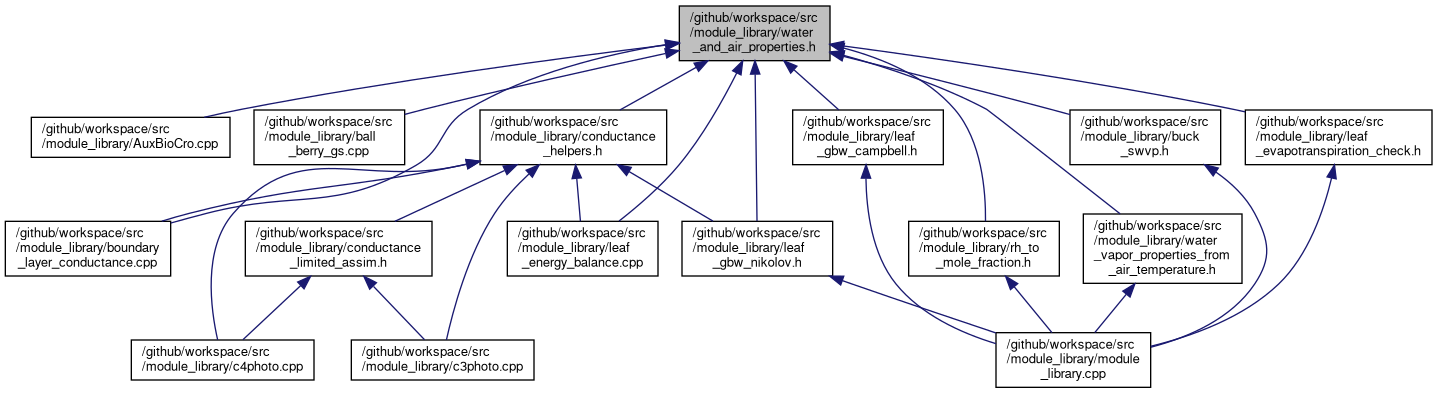
Go to the source code of this file.
Functions | |
| double | molar_volume (double temperature, double pressure) |
| Determine the volume of one mole of an ideal gas using the ideal gas law. More... | |
| double | saturation_vapor_pressure (double air_temperature) |
| Determine saturation water vapor pressure (Pa) from air temperature (degrees C) using the Arden Buck equation. More... | |
| double | TempToDdryA (double air_temperature) |
| Determines the density of dry air from the air temperature. More... | |
| double | dry_air_density (const double air_temperature, const double air_pressure) |
| Calculate the density of dry air from temperature and pressure using the ideal gas law. More... | |
| double | TempToLHV (double temperature) |
| Determine the latent heat of vaporization for water from its temperature. More... | |
| double | water_latent_heat_of_vaporization_henderson (double temperature) |
| Determine the latent heat of vaporization of water from its temperature. More... | |
| double | TempToSFS (double air_temperature) |
| Determine the derivative of saturation water vapor density with respect to temperature at a particular value of air temperature. More... | |
| double | TempToCp (double air_temperature) |
| Determine the specific heat capacity of dry air at constant pressure (c_p) at a particular value of air pressure. More... | |
| double | vapor_density_from_pressure (double density_of_dry_air, double total_pressure, double vapor_pressure) |
| Use Equation 14.5a from Thornley & Johnson (1990) to calculate water vapor density from water vapor pressure. More... | |
Function Documentation
◆ dry_air_density()
|
inline |
Calculate the density of dry air from temperature and pressure using the ideal gas law.
Assuming the air behaves like an ideal gas, its molar volume MV (in m^3 / mol) can be found using the molar_volume() function. Then its density can be found using the molar mass MM of air (in kg / mol) as MM / MV.
See https://en.wikipedia.org/wiki/Density_of_air for details.
- Parameters
-
[in] air_temperature Air temperature in degrees C [in] air_pressure Air pressure in Pa
- Returns
- Density of dry air in kg / m^3
Definition at line 115 of file water_and_air_properties.h.
References molar_volume().
Referenced by leaf_energy_balance().
Here is the call graph for this function: Here is the caller graph for this function: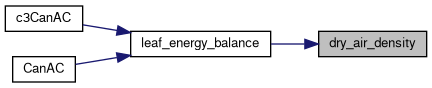
◆ molar_volume()
|
inline |
Determine the volume of one mole of an ideal gas using the ideal gas law.
The ideal gas law is: PV = nRT. Solving for V/n, we have V/n = RT / P.
The ideal gas constant R has units J / K / mol, so the molar volume has units J / mol / Pa. However, note that 1 Pa = 1 N / m^2 and 1 J = 1 N * m, so 1 J / mol / Pa = 1 N * m / mol / (N / m^2) = 1 m^3 / mol.
- Parameters
-
[in] temperature Gas temperature in degrees C [in] pressure Gas pressure in Pa
- Returns
- Molar volume in m^3 / mol
Definition at line 25 of file water_and_air_properties.h.
Referenced by dry_air_density(), g_to_mass(), and g_to_molecular().
Here is the caller graph for this function: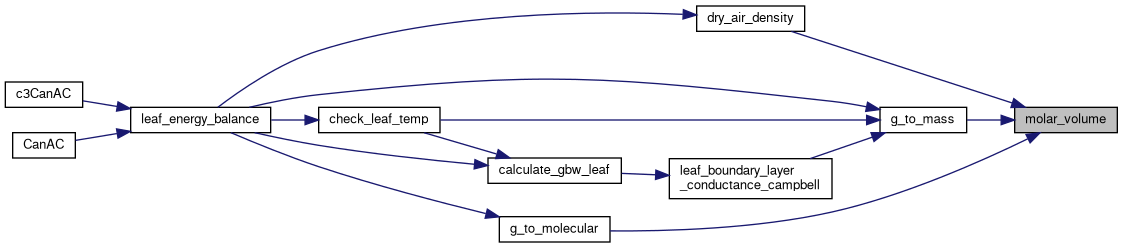
◆ saturation_vapor_pressure()
|
inline |
Determine saturation water vapor pressure (Pa) from air temperature (degrees C) using the Arden Buck equation.
Equations of this form were used by Arden Buck to model saturation water vapor pressure in 1981: [A. L. Buck, J. Appl. Meteor. 20, 1527–1532 (1981)] (https://doi.org/10.1175/1520-0450(1981)020%3C1527:NEFCVP%3E2.0.CO;2)
In 1996, some of the fitting coefficients were updated. Here we use these updated values, found in [a Buck hygrometer manual] (https://www.hygrometers.com/wp-content/uploads/CR-1A-users-manual-2009-12.pdf), and also displayed on the [Wikipedia page for the Arden Buck equation] (https://en.wikipedia.org/wiki/Arden_Buck_equation).
We use the values for vapor over water (rather than ice) and disregard the "enhancement factor" since we are only concerned with the pressure at saturation.
- Parameters
-
[in] air_temperature Air temperature in degrees C
- Returns
- Saturation water vapor pressure in Pa
Definition at line 58 of file water_and_air_properties.h.
Referenced by ball_berry_gs(), leaf_boundary_layer_conductance_nikolov(), leaf_energy_balance(), and SoilEvapo().
Here is the caller graph for this function: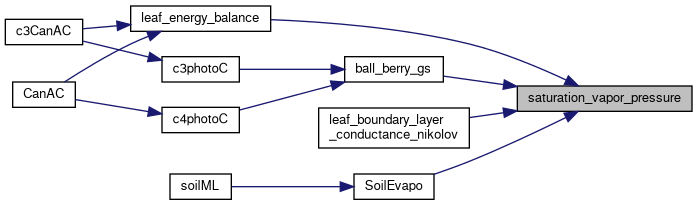
◆ TempToCp()
|
inline |
Determine the specific heat capacity of dry air at constant pressure (c_p) at a particular value of air pressure.
The Thermophysical Properties of Matter Database provides several functions for calculating the specific heat of air, which is designated as material M91 in the database (https://cindasdata.com/products/tpmd). Here we use Equation 3, which is described as follows:
A number of experimental and theoretical values are also available for the specific heat in the real gas state. Among them, the derived values of Hilsenrath et al. (575), which are also compiled in various reports (132, 260, 313, 454, 481), are considered to be the most reliable in the temperature range from 260 K up to 900 K. Therefore, their values are fitted to the following equations in the present analysis of the real gas specific heat.
For temperatures between 260 K and 610 K:
C(p) (cal g[-1]K[-1]) = 0.249679 - 7.55179 x 10[-5]T + 1.69194 x 10[-7]T[2]- 6.46128 x 10[-11]T[3] (T in K). (3)
Note that 260 - 610 K corresponds to approximately -13 to 337 degrees C, so this equation should be accurate for any temperatures relevant to crop growth.
Here we use this equation, but convert the result from cal / g / K to J / kg / K using 1 cal / g = 4184 cal / kg
- Parameters
-
[in] air_temperature Air temperature in degrees C
- Returns
- Specific heat capacity of dry air in J / kg / K.
Definition at line 250 of file water_and_air_properties.h.
Referenced by leaf_energy_balance().
Here is the caller graph for this function: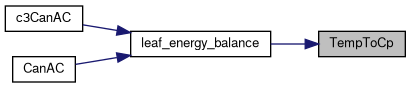
◆ TempToDdryA()
|
inline |
Determines the density of dry air from the air temperature.
This function appears to be derived from fitting a linear equation to the values of rho in Table 14.3 on pg. 408 in Thornley and Johnson (1990):
| T (degrees C) | rho (kg / m^3) |
|---|---|
| 0 | 1.29 |
| 5 | 1.27 |
| 10 | 1.25 |
| 15 | 1.23 |
| 20 | 1.20 |
| 25 | 1.18 |
| 30 | 1.16 |
| 35 | 1.15 |
| 40 | 1.13 |
Thornley, J.H.M. and Johnson, I.R. (1990) Plant and Crop Modelling. A Mathematical Approach to Plant and Crop Physiology.
- Parameters
-
[in] air_temperature Air temperature in degrees C
- Returns
- Density of dry air in kg / m^3
Definition at line 92 of file water_and_air_properties.h.
Referenced by SoilEvapo().
Here is the caller graph for this function:
◆ TempToLHV()
|
inline |
Determine the latent heat of vaporization for water from its temperature.
This function appears to be derived from fitting a linear equation to the values of lambda in Table 14.3 on pg. 408 in Thornley and Johnson (1990):
| T (degrees C) | lambda (MJ / kg) |
|---|---|
| 0 | 2.50 |
| 5 | 2.49 |
| 10 | 2.48 |
| 15 | 2.47 |
| 20 | 2.45 |
| 25 | 2.44 |
| 30 | 2.43 |
| 35 | 2.42 |
| 40 | 2.41 |
Thornley, J.H.M. and Johnson, I.R. (1990) Plant and Crop Modelling. A Mathematical Approach to Plant and Crop Physiology.
- Parameters
-
[in] temperature Water temperature in degrees C
- Returns
- Latent heat of vaporization for water in J / kg
Definition at line 151 of file water_and_air_properties.h.
Referenced by SoilEvapo().
Here is the caller graph for this function:
◆ TempToSFS()
|
inline |
Determine the derivative of saturation water vapor density with respect to temperature at a particular value of air temperature.
This function appears to be derived from fitting a quadratic function to the values of s in Table 14.3 on pg. 408 in Thornley and Johnson (1990):
| T (degrees C) | s (10^(-3) kg / m^3 / K) |
|---|---|
| 0 | 0.33 |
| 5 | 0.45 |
| 10 | 0.60 |
| 15 | 0.78 |
| 20 | 1.01 |
| 25 | 1.30 |
| 30 | 1.65 |
| 35 | 2.07 |
| 40 | 2.57 |
Thornley, J.H.M. and Johnson, I.R. (1990) Plant and Crop Modelling. A Mathematical Approach to Plant and Crop Physiology.
- Parameters
-
[in] air_temperature Air temperature in degrees C
- Returns
- Derivative of saturation water vapor pressure with respect to temperature in kg / m^3 / K (equivalent to Pa / K)
Definition at line 208 of file water_and_air_properties.h.
Referenced by leaf_energy_balance(), and SoilEvapo().
Here is the caller graph for this function: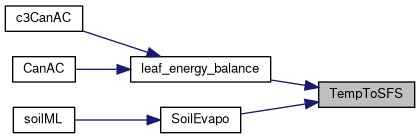
◆ vapor_density_from_pressure()
|
inline |
Use Equation 14.5a from Thornley & Johnson (1990) to calculate water vapor density from water vapor pressure.
This equation is described as follows:
Before considering the bahavior of eqn (14.4k), we should point out that vapour pressure rather than vapour density is frequently used in the treatment of evaporation and transpiration (e.g. Monteith 1973, Jones 1983). It can be shown (Exercise 14.3) that vapour density and pressure are related by
rho_v = rho * epsilon * p_v / (P - p_v), (14.5a)where
Pis the total atmospheric pressure (dry air plus water vapour) (Pa),p_vis the vapour pressure (or partial vapour pressure) (Pa),rho, as defined above, is the density of dry air (kg / m^3), andepsilonis the ratio of the relative molecular mass of water to the relative molar mass of dry air (epsilon= 0.622 (Exercise 14.3)).
Note: eqn (14.4k) is the Penman-Monteith equation for canopy transpiration as expressed in this source.
Definition at line 286 of file water_and_air_properties.h.
Referenced by leaf_energy_balance().
Here is the caller graph for this function:
◆ water_latent_heat_of_vaporization_henderson()
|
inline |
Determine the latent heat of vaporization of water from its temperature.
Here we use Equation 8 from [Henderson-Sellers, B. "A new formula for latent heat of vaporization of water as a function of temperature" Quarterly Journal of the Royal Meteorological Society 110, 1186–1190 (1984)] (https://doi.org/10.1002/qj.49711046626)
- Parameters
-
[in] temperature Water temperature in degrees C
- Returns
- Latent heat of vaporization for water in J / kg
Definition at line 171 of file water_and_air_properties.h.
Referenced by leaf_energy_balance().
Here is the caller graph for this function:
